
Skip to content
AnnouncementInitial release: self-hosted on Ubuntu 24.04 and 26.04 LTS. More platforms planned; Cloud and managed services are outside this release.First release: self-hosted on Ubuntu LTS.Release status
Register Cloud interest

Coding-agent orchestration from task to validated pull request

BranchRunner is coding-agent orchestration software for engineering organizations. It holds the objective, provisions isolated workspaces, coordinates agents, records validation evidence, and routes work through human approval. It is not a coding model or IDE assistant.

LifecycleTaskRunWorkspaceAgent sessionsValidationHuman approvalPull request

Four objects, used consistently

The product model is small on purpose. Everything the platform shows you — cost, evidence, approvals, audit history — hangs off one of these four.

TaskDurable

The objective, its requirements and the human conversation. It outlives every attempt made against it.

Holds
Requirements ledger
Holds
Conversation and decisions
Holds
Runs and outcomes
RunOne attempt

One execution of the task. A failed run keeps its logs and evidence; the next attempt starts from what was learned.

Holds
Plan and steps
Holds
Budget, duration, cost
Holds
Approvals and audit events
WorkspaceIsolated

The Git worktree and Docker environment a run executes in, on a runtime worker rather than the control plane.

Holds
Worktree and branch
Holds
Containers and preview
Holds
Egress rules and secret references
Agent sessionOne participant

A primary or specialist agent taking part in a run, with its own role, provider, permissions and cost.

Holds
Role and provider
Holds
Steps and tool activity
Holds
Tokens and spend
Task workbench

The objective and the work in one view

Requirements on the left, the live run in the middle, the inspector on the right. Nothing about the task lives in a chat window that closes.

Work items12
482Retry failed webhook deliveriesRunning
479Upgrade the payment SDKReview
474Fix flaky checkout testAttention
466Split the billing workerQueued
461Remove the legacy webhook pathCompleted
TASK-482Run 18 running
Retry failed webhook deliveries with exponential backoff
R1Backoff is exponential with jitterSatisfied
R2Retries stop after five attemptsSatisfied
R3Alert fires on final failureIn progress
R4Checkout flow unaffectedNot yet verified
Reply here to redirect the run. The agents read the task conversation, not a separate chat.
Inspector
Run
18 · attempt 2
Workspace
env-br-482-a
Sessions
3 · 1 running
Spend
$4.20 of $12.00
Duration
26m 41s
Source
Linear · LIN-482
Multi-agent execution

A primary agent that delegates, and specialists that can work at the same time

The primary session owns the plan. Specialist sessions take steps from it, each with its own role, provider and permissions. When two of them touch the codebase at once, they do it in separate worktrees and integrate in a merge workspace.

01Roles before providers. A session is a planner, implementer, reviewer or oversight agent first. Which model serves it is configuration.
02Progress you can read. Current step, tool calls, files touched, tokens and spend, per session, while it runs.
03Independent review. The reviewing session does not inherit the implementer's context, so it reads the diff rather than the reasoning that produced it.
04Reasoning summaries, not chain-of-thought. Sessions record decisions, assumptions, evidence and next actions.
Agent sessions · run 18
  • PlannerPrimary · owns the planCompleted
    • Implementerworker-2 · worktree a · 48.2k tokensRunning
    • Implementeralerting · worktree b · 31.7k tokensCompleted
    • Reviewermerge workspace · no shared contextQueued
    • Oversightintegration and handoffQueued
Worktree a
runs/br-482-api
Worker service and tests
Worktree b
runs/br-482-alert
Alerting path only
Merge workspace
runs/br-482
Integration before review
Isolated workspaces

Every run gets its own Git worktree and container set

Runtime workers hold a local mirror of the repository, so a new worktree does not need to authenticate to your Git provider. Provider credentials are used only for remote fetch, push and pull-request operations.
·Ordinary Docker infrastructure. Kubernetes is not required.
·Docker Compose environments defined per repository, with a preview URL when the task needs one.
·Workers are added, labelled and scheduled by capacity and concurrency limits.
·Failed runs keep their workspace for inspection; successful ones are cleaned up on a retention policy.
env-br-482-aHealthy
api
:4000 healthy
worker
running
postgres
:5432 healthy
preview
:3000 healthy
env-br-479-aUnhealthy
api
:4000 healthy
worker
restarting
preview
never healthy
logs
Preserved
Worker capacity
worker-1 · eu-west3 of 4 runs
worker-2 · eu-west2 of 4 runs
worker-3 · on-premise0 of 2 runs
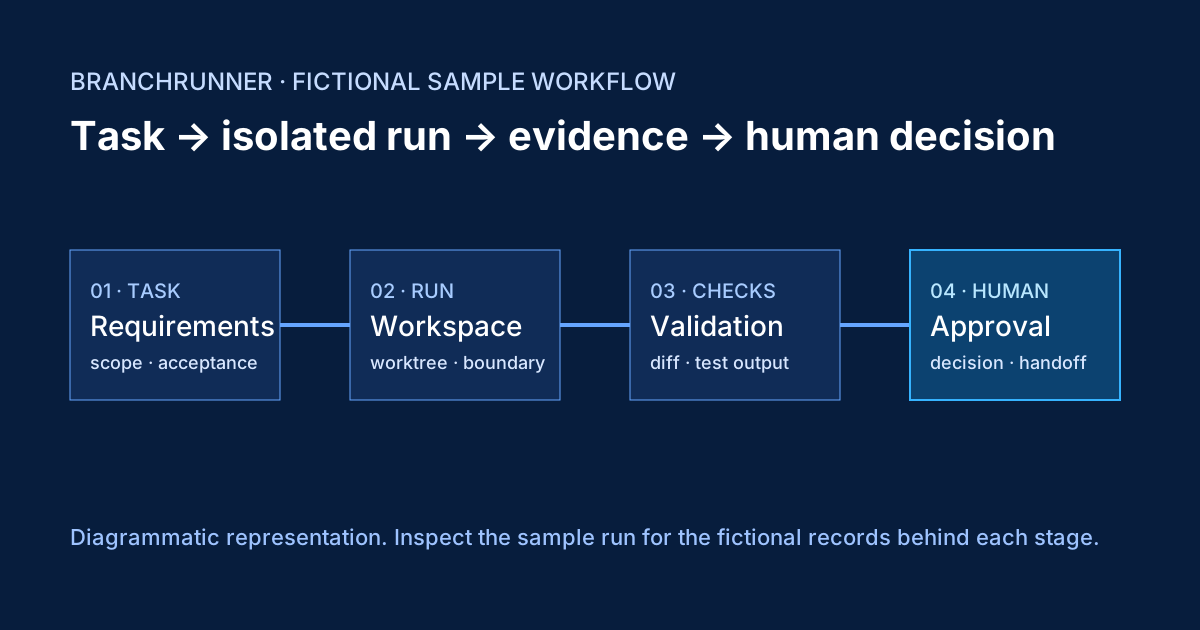
Diagram showing requirements, isolated workspace, validation evidence, and human approval in a fictional coding-agent workflow.
The product workflow represented in the UI: a task, isolated execution, checks, and a human decision. Inspect the fictional sample run for the full walkthrough.
Human governance

Approval is a workflow state, not a notification

A run that needs a person stops and says so. The decision is recorded against the run, with the evidence that informed it and the identity of whoever made it.

Intervene mid-run

Reply in the task to correct an assumption, pause the run, or cancel it and keep the workspace for inspection.

PauseRedirectCancel and keep
Approvals with the proof attached

Destructive tool use, external deployment and handoff between stages can each require a named person.

Approve handoff to review
4 requirements satisfied · 3 checks passed · 41 lines added
Budgets that actually stop work

Soft thresholds warn the owner. Hard limits end the run and preserve everything produced so far.

Spend$4.20 of $12.00
Concurrency5 of 6 runs
Attributable, months later

Every approval, tool call, secret reveal and policy decision is an event on the run, exportable for review.

14:04:01Approval requested · destructive command
14:05:37Declined by example reviewer
14:31:12Handoff approved · PR #1284 opened
Validation and evidence

Claims are separated from proof

Checks attach to the requirement they satisfy. An agent's statement that something works is labelled as agent-reported until a test, a preview or a reviewer says otherwise.

Evidence labels
Agent-reportedThe session says the requirement is met. Nothing has confirmed it.
Independently validatedA check or a separate reviewing session confirmed it.
Human-approvedA named person accepted the evidence and released the work.
Not yet verifiedStill open. The run cannot complete against it.
src/workers/webhook.ts+41 −7
@@ -39,7 +41,9 @@ export async function deliver(job) {
3941 if (!response.ok) {
40− return requeue(job, 1000);
42+ const base = jitter(250);
43+ const delay = base * 2 ** job.attempt;
44+ return requeue(job, delay);
4146 }

Integrations directory

Filter by what an integration does. Status reflects the launch release: planned integrations are listed so you can see the direction, and cannot be installed.

GitHubAvailable
Git and issue provider

Repository access, branch and pull-request delivery, issue import.

Community target; managed offerings plannedDocs
GitLabPlanned
Git and issue provider

Repository access and merge-request delivery. Issue import in progress.

PlannedDocs
LinearPlanned
Issue provider

Import work items as tasks and keep Linear authoritative for status.

PlannedDocs
JiraPlanned
Issue provider

Import work items and post run outcomes back to the issue.

PlannedDocs
BitbucketPlanned
Git provider

Repository access and pull-request delivery.

PlannedDocs
OpenAI CodexPrivate preview
Coding agent

Planner, implementer or reviewer sessions under your own credentials.

Community target; managed offerings plannedDocs
Claude CodePrivate preview
Coding agent

Planner, implementer or reviewer sessions under your own credentials.

Community target; managed offerings plannedDocs
Gemini CLIPrivate preview
Coding agent

Planner, implementer or reviewer sessions under your own credentials.

Outside initial offeringDocs
OpenCodePrivate preview
Coding agent

Planner, implementer or reviewer sessions under your own credentials.

Outside initial offeringDocs
Self-hosted modelsPrivate preview
Model provider

OpenAI-compatible endpoints for local or private model serving.

Outside initial offeringDocs
DockerAvailable
Runtime provider

Workspace containers and preview services on ordinary Docker hosts.

Community target; managed offerings plannedDocs
Docker ComposeAvailable
Runtime provider

Per-repository environment definitions, including preview URLs.

Community target; managed offerings plannedDocs
Remote workersAvailable
Runtime provider

Additional labelled workers with their own concurrency limits.

Community target; managed offerings plannedDocs
KubernetesPlanned
Runtime provider

Scheduling workspaces onto an existing cluster.

PlannedDocs
MCP serversAvailable
Tools

Attach MCP tools per workflow, with per-role permission scoping.

Community target; managed offerings plannedDocs
Database toolsAvailable
Tools

Read-only queries by default; write access requires approval.

Community target; managed offerings plannedDocs
Browser automationAvailable
Tools

Drive a preview environment for smoke tests and screenshots.

Community target; managed offerings plannedDocs
Environment secretsAvailable
Secrets

Store references, inject values at run time, log every reveal.

Community target; managed offerings plannedDocs
External secret managersPlanned
Secrets

Resolve references from your existing vault at run time.

PlannedDocs
Single sign-onAvailable
Identity

Sign in through the identity provider configured for the deployment.

Community target; managed offerings plannedDocs
SCIM provisioningPlanned
Identity

Directory-driven provisioning and deprovisioning.

EnterpriseDocs
WebhooksAvailable
Communication

Run lifecycle, attention requests and completion events.

Community target; managed offerings plannedDocs
SlackBeta
Communication

Attention requests and approvals routed to a channel.

Community target; managed offerings plannedDocs
Metrics exportPlanned
Observability

Run duration, cost and outcome series for your own dashboards.

PlannedDocs

Provider names are used descriptively. Logos appear only where trademark use is permitted.

What is BranchRunner?

BranchRunner is coding-agent orchestration software for engineering organizations. It connects task scope, isolated workspaces, validation, approval and evidence around coding-agent work.

How is it different from a coding agent?

A coding agent performs work in a session. BranchRunner is the operational layer that coordinates multiple sessions, workspace boundaries, policies, checks and human decisions.

Can it run in our environment?

The initial release targets self-hosted Ubuntu 24.04 and 26.04 LTS. Cloud and Enterprise are future offerings and are not assessed for activation today.

Which controls are visible?

The product model shows requirements, run state, workspace context, validation results, approval decisions and audit evidence. Availability of deployment-specific controls is confirmed in scope.

What should we inspect first?

Start with the fictional sample run, architecture and evaluation scorecard. They are ungated and distinguish example records from verified customer evidence.

Deployment and operational responsibility

The initial release is self-hosted. Cloud and Enterprise show possible future operating models and are not current editions.

Community
Self-managed evaluation path
Published operating model, not an install promise
Release artifact and license terms are not published
Supported-host and rollback guidance are not published
Review the architecture before planning an evaluation
Cloud
Future managed direction
Managed control plane under consideration
Managed worker capacity under consideration
Upgrade and backup model not yet defined
Repository and credential boundary not yet defined
Cloud is a future offering; no current managed service, pricing, or terms are offered.
Enterprise
Future organizational direction
Deployment models under consideration
Worker pools and private networking planned
Upgrade and release model not yet defined
Support and SLA not currently offered

Air-gapped deployment, dedicated topology, custom regions, provider access, and offline updates are future Enterprise direction and are not currently offered.

Security and governance, in short

Security and Trust Center
Execution boundary

Agents run in workspaces on runtime workers, never on the control plane.

Secrets as references

Values are injected at run time. Reveal and copy are logged; deletion lists affected workflows.

Provider boundaries

Which provider receives which context is visible per session, under your credentials.

Permissions and policy

Roles scope what a session may read, write and execute. Escalation requires a person.

Egress control

Network access from a workspace is allowlisted per environment and per run.

Audit and retention

Runs, approvals and evidence are retained on a policy you set, and can be exported.

Run it yourself

Review the self-managed operating model before a released artifact and license are available.

Future managed direction

A managed control plane and workers are future product direction, not a current service offer.

Scale it across the organization

Future policy, identity and retention capabilities under consideration.