
Govern AI development across your engineering organization
Enterprise is a future offering outside the initial self-hosted release. The capabilities below describe product direction and are not current service, deployment, or support commitments.
What Enterprise adds to the platform
The planned orchestration model builds on the self-hosted product direction. Enterprise describes a possible future organization-wide offering.
Dedicated capacity per team, region or network zone, with concurrency limits that reflect how you fund them.
Approval rules, tool permissions and spend limits set centrally, inherited by every team and repository.
Single sign-on, granular roles, and SCIM provisioning are part of the planned Enterprise direction.
Keep runs, approvals, diffs and check output for the period your policy requires, with export for review.
Redundant control-plane deployment, documented backup and restore procedures, and tested recovery objectives.
Workers in your VPC or on-premise network, reaching internal services without exposing them publicly.
Choose a stable channel and an upgrade window, with migration support for the versions you skip.
Named contacts, agreed response times by severity, and an escalation path that reaches engineering.
Architecture review, questionnaire support, subprocessor disclosure and contractual data-processing terms.
No Enterprise deployment mode, support service, response target, region, or launch date is currently offered.
Who is Enterprise intended for?
Enterprise is future product direction for organizations interested in scoped administration, deployment arrangements, and private connectivity around the same core orchestration model.
Which controls are enforced?
Published controls and availability are shown in the feature matrix and Trust Center. Any deployment-specific identity, policy, retention, or support commitment must be confirmed in scope.
Can Enterprise run in our environment?
No Enterprise deployment is currently offered. Self-managed, private, and dedicated models describe future direction only.
How is Enterprise priced?
No Enterprise pricing is currently offered. This page intentionally does not invent a price, limit, currency, tax treatment, or contractual term.
What does an evaluation include?
An evaluation should define a workflow, controls, validation, review evidence, deployment constraints, and success measures before any claims about outcomes are made.
Deployment options
An offline deployment model is under consideration; no air-gapped Enterprise service is currently offered.
Reference architecture for a multi-team organization
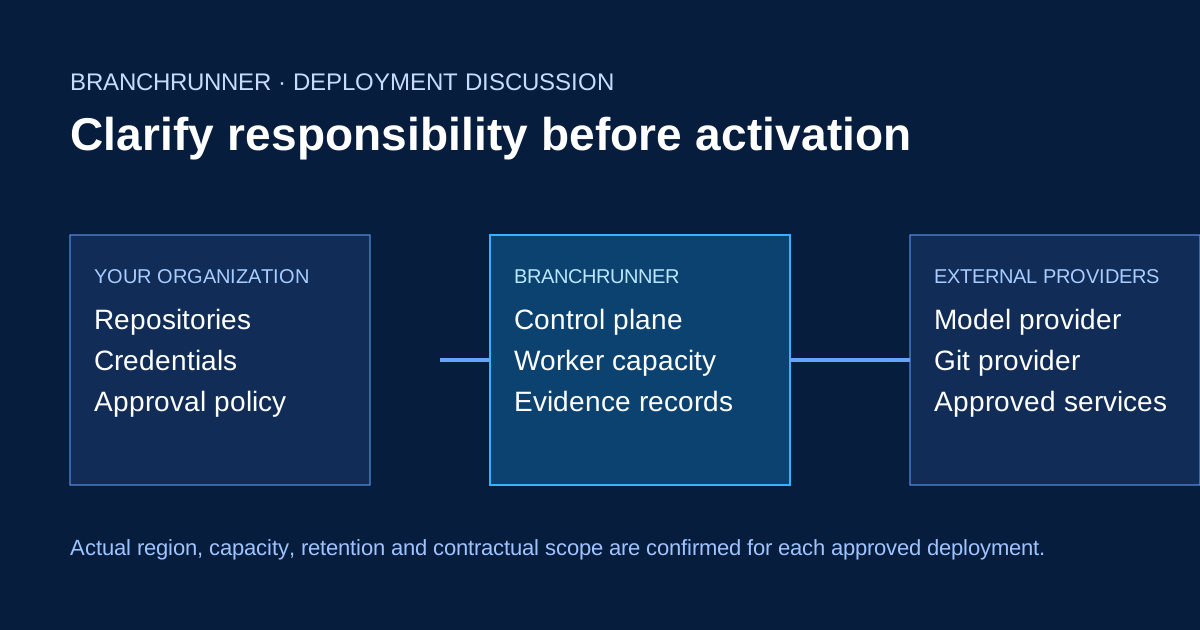
One control plane, several worker pools, and a clear line where code and context cross a network boundary.
Enterprise feature matrix
Only the rows where the editions differ. Everything else is identical because it is the same platform.
Planned support direction
Enterprise questions
Can BranchRunner run entirely inside our network?
The initial release is self-hosted only. Private-network and air-gapped Enterprise models are future product direction, not current deployment offers.
Which Enterprise deployment modes are planned?
Self-managed, dedicated, and air-gapped models are under consideration. No Enterprise deployment mode, topology, region, capacity, or support boundary is currently offered.
How do you handle security reviews?
Current public documents are listed on the security page. Any future Enterprise review process will be described when that offering is ready.
What does the SLA cover?
No Enterprise SLA or response target is currently offered. Any future commitment would apply only through explicit published or contracted terms.
Can different teams use different model providers?
Yes. Providers are configured per workflow, so one team can use a private endpoint while another uses a commercial provider, under separate credentials.
How is Enterprise priced?
No Enterprise pricing is currently offered. Possible future dimensions include organization scope, worker capacity, and support level.
This site does not present customer outcomes, testimonials, or adoption claims. Use the fictional sample run and evaluation scorecard to inspect the proposed operating model and define your own measurement approach.
Register interest in a future Enterprise offering
Tell us which organization-wide controls matter to you. This records future interest; it is not a demo booking, service offer, or promise of follow-up.